

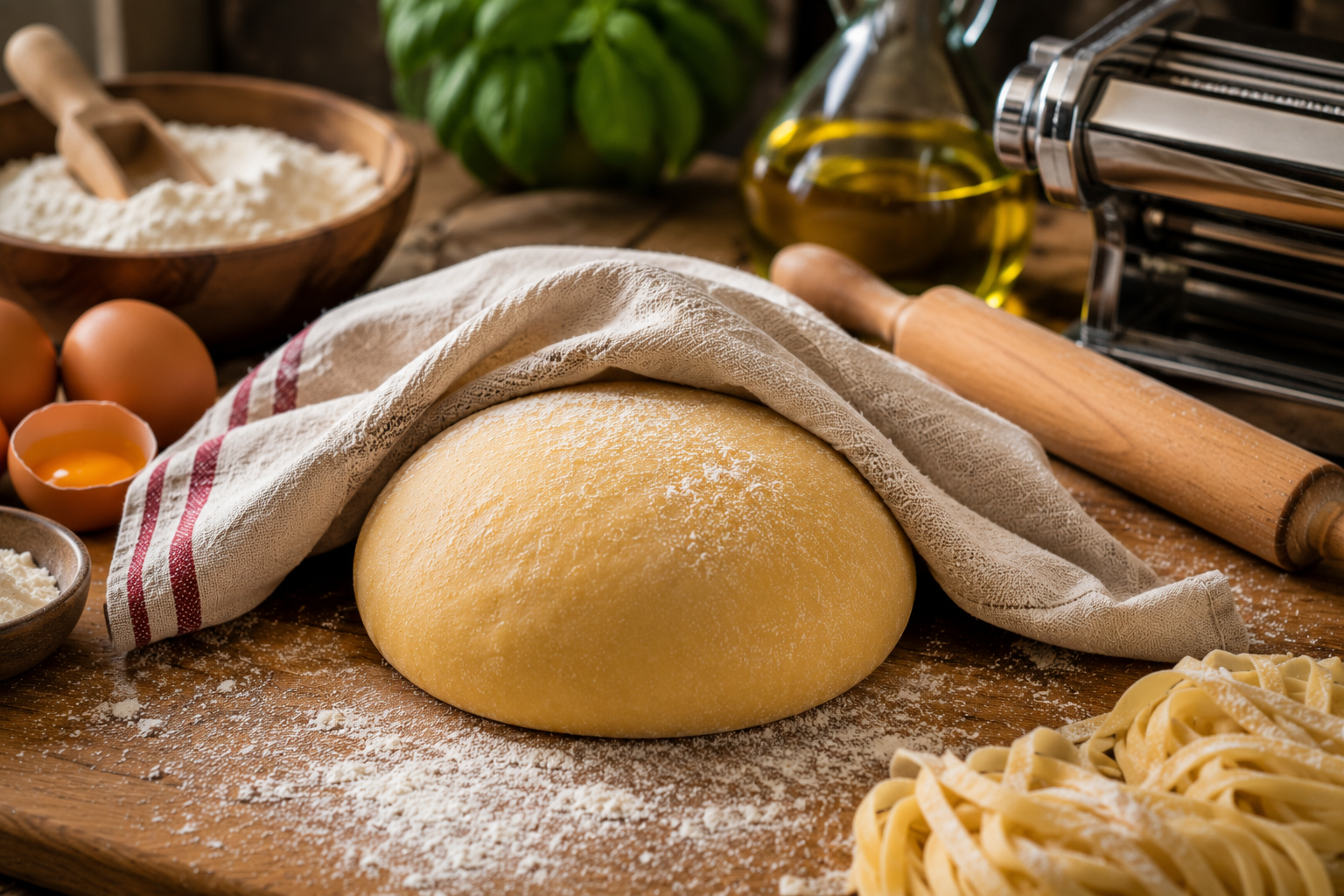
Why Pasta Dough Needs to Rest: The Secret Most Beginners Skip (Part 2)
By now, you know that resting pasta dough isn’t simply a pause in the recipe—it’s an essential stage in creating exceptional pasta. As the gluten relaxes and moisture distributes evenly throughout the dough, the transformation becomes noticeable not only in how the dough feels, but in every step that follows.
Let’s take a closer look at what resting changes once you begin rolling, shaping, and cooking your pasta.
Rolling Becomes Effortless
If you’ve ever struggled to feed dough through a pasta machine, chances are the dough wasn’t fully rested.
Freshly kneaded dough has a tendency to resist every pass through the rollers. It may spring back immediately after being rolled or require repeated passes through the same setting.
Properly rested dough behaves very differently.
It glides through the rollers.
It stretches instead of resisting.
It becomes thinner with fewer passes.
Most importantly, it maintains a consistent thickness from edge to edge.
Even if you’re rolling by hand with a traditional rolling pin, you’ll notice that rested dough requires significantly less effort.
Rather than fighting the dough, you’re guiding it.
This is one of the reasons experienced Italian pasta makers often appear so graceful while rolling enormous sheets of dough. Their technique certainly matters—but so does their patience before they ever begin.
Filled Pasta Depends on Proper Resting
Some pasta shapes are surprisingly forgiving.
Tagliatelle or pappardelle can often hide small imperfections.
Filled pasta cannot.
Whether you’re making ravioli, tortellini, cappelletti, or agnolotti, the dough must be flexible enough to wrap around the filling without tearing.
If the gluten is still tight, several problems appear:
- The edges split while folding.
- Air pockets become trapped.
- Corners crack.
- The dough pulls away from the filling.
- Seals become weak.
Rested dough stretches smoothly around fillings, creating tight seals that remain intact during cooking.
This is why many Italian families preparing holiday ravioli or tortellini often make the dough first, then prepare the filling while the dough rests.
The timing works beautifully.
Better Texture After Cooking
Many people assume resting only affects shaping.
In reality, it also influences the finished texture.
Because hydration becomes more even during the resting period, the pasta cooks more consistently.
Instead of having tiny areas that remain slightly dry or dense, the entire noodle reaches the same level of tenderness.
The result is pasta with a smoother bite and a more uniform texture from end to end.
It’s a subtle difference, but one that becomes immediately noticeable when compared side by side.
Can Pasta Dough Rest Too Long?
This is another common question.
The short answer is:
Yes—but only under certain conditions.
At room temperature, most fresh pasta dough is happiest resting for about 30 to 60 minutes.
Longer than that isn’t usually harmful, but the dough should remain well covered so it doesn’t begin drying out.
If you’re planning to wait several hours—or until the next day—the refrigerator becomes the better option.
Many professional kitchens intentionally prepare pasta dough the day before using it.
An overnight rest allows hydration to continue while fitting naturally into the kitchen’s workflow.
The next day, the dough often feels beautifully smooth and easy to handle.
Just remember to allow refrigerated dough to warm slightly before rolling.
Cold dough is naturally firmer and may crack if rolled immediately.
The Biggest Mistakes Beginners Make
One of the advantages of understanding why dough rests is that you’ll begin recognizing mistakes before they become problems.
Mistake #1: Skipping the Rest Entirely
This is by far the most common.
The result is usually dough that feels stubborn, shrinks constantly, and tears more easily.
Ironically, skipping the rest often makes the entire process take longer because you’re forced to fight the dough every step of the way.
Mistake #2: Leaving the Dough Uncovered
Even fifteen minutes of exposure to air can begin drying the outer surface.
That thin dry layer eventually becomes tiny cracks during rolling.
Always wrap the dough tightly or cover it completely.
Protecting moisture is just as important as allowing time.
Mistake #3: Adding More Flour Too Soon
Many beginners mistake tight gluten for dry dough.
The instinct is to add water.
Or worse, continue adding flour because the dough feels firm.
Often, neither adjustment is necessary.
The dough simply needs time.
Before changing your recipe, give it thirty minutes.
You may be surprised how dramatically it improves on its own.
Mistake #4: Confusing Sticky with Under-Rested
A sticky dough isn’t always under-rested.
Sometimes it simply contains too much moisture.
Resting may improve the texture slightly as the flour continues hydrating, but excessively wet dough usually requires a small amount of additional flour.
Learning to distinguish between these situations comes with experience.
That’s why experienced pasta makers rely more on touch than measurements.
Learning to Read the Dough
Perhaps the greatest lesson resting teaches isn’t patience.
It’s observation.
Instead of asking,
“How many minutes has it rested?”
Experienced pasta makers ask,
“How does it feel?”
A rested dough should feel:
- Smooth
- Firm but pliable
- Slightly springy
- Evenly hydrated
- Easy to flatten without cracking
Those characteristics matter far more than the exact number of minutes on a timer.
The dough is always communicating.
The more often you make pasta, the more fluent you become in its language.
Resting Is About Respecting the Process
Italian cooking has never been obsessed with shortcuts.
Many of its greatest dishes ask us to slow down.
A ragù simmers for hours.
Parmigiano Reggiano ages for years.
Prosciutto cures over many months.
Fresh pasta asks for something much smaller:
Thirty minutes.
In return, it rewards you with dough that’s easier to shape, cooks more evenly, and produces pasta that looks and feels noticeably more refined.
Sometimes the simplest ingredient isn’t flour or eggs.
Sometimes it’s patience.
Did You Know?
Some traditional sfogline in Emilia-Romagna judge whether dough has rested long enough simply by pressing it gently with a fingertip.
If the indentation slowly springs back without immediately disappearing, the dough is often ready to roll. It’s a technique passed from one generation to the next—no timer required.
Italian Word of the Day
Sfoglia (SFOHL-yah)
Meaning: A thin sheet of rolled pasta dough.
The word sfoglia refers to the delicate sheet of dough that becomes lasagna, tagliatelle, ravioli, tortellini, and countless other fresh pasta shapes.
Creating beautiful sfoglia begins long before the rolling pin touches the dough—it begins with proper resting.
Regional Spotlight: Emilia-Romagna
In kitchens throughout Bologna and the surrounding countryside, generations of sfogline have demonstrated that great pasta is as much about rhythm as technique.
The dough is mixed.
Then it rests.
Only after that quiet pause does the rolling begin.
For these master pasta makers, resting isn’t viewed as waiting.
It’s simply another step in the craft.
That mindset has helped preserve one of Italy’s most celebrated culinary traditions for centuries.
Pasta Fiore Tip
One of the easiest ways to make pasta day feel more relaxed is to work with the resting time instead of around it.
After mixing your dough, wrap it tightly and let it rest while you prepare your sauce, grate your cheese, organize your workspace, or make your filling.
By the time everything else is ready, your dough will be too—and your entire cooking process will flow naturally.
From the Pasta Fiore Kitchen
One of the most valuable lessons homemade pasta has taught me is that not every step requires action.
Sometimes the best thing you can do is simply trust the process.
It’s tempting to keep working the dough, adjusting ingredients, or wondering if you’ve done something wrong. But often, the dough isn’t asking for more flour or more kneading—it’s simply asking for a little time.
When you give it that time, something wonderful happens. The dough softens, your work becomes easier, and the finished pasta reflects a quiet truth that’s at the heart of Italian cooking:
The finest results often come not from rushing toward the meal, but from enjoying the craft of creating it.