

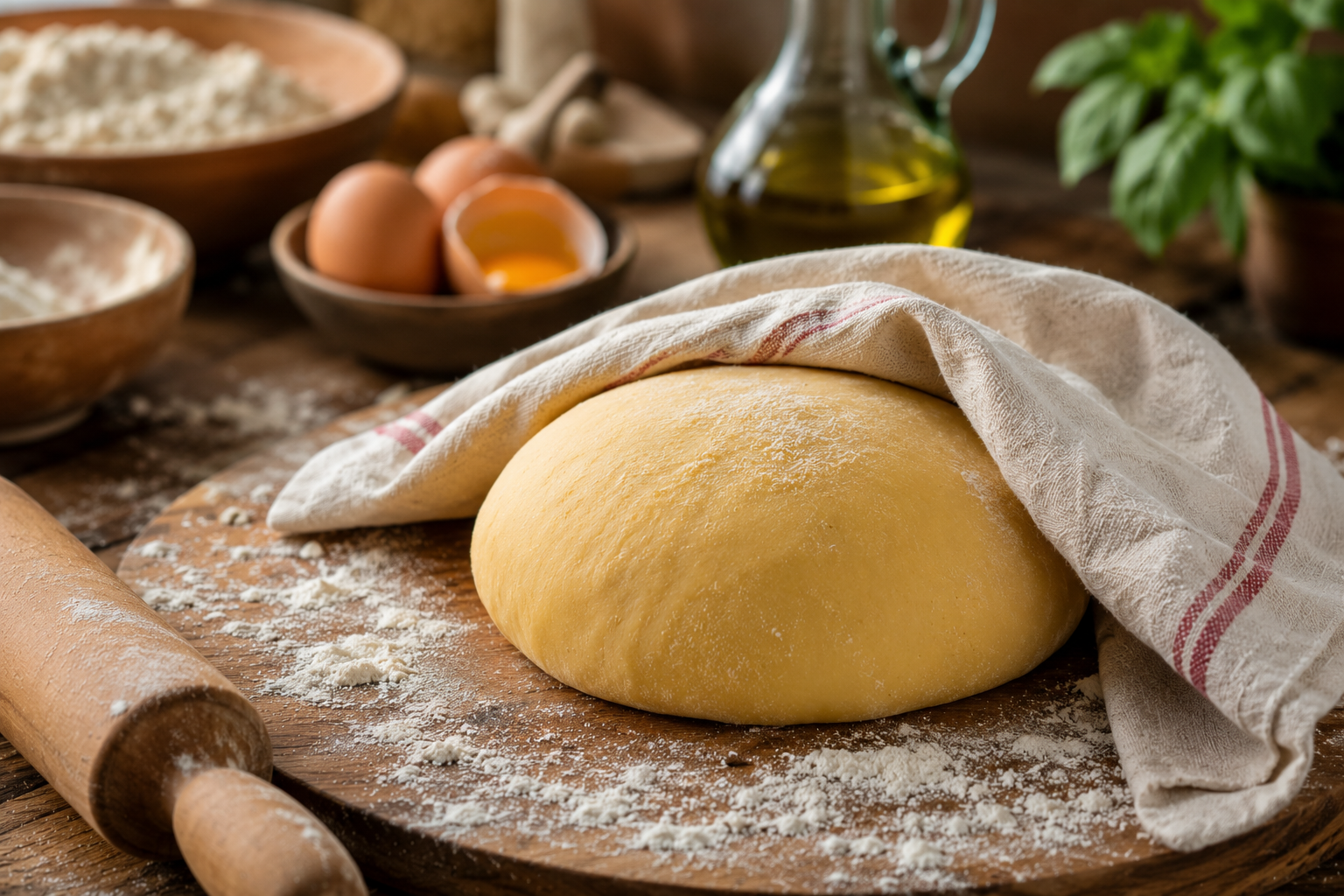
Why Pasta Dough Needs to Rest: The Secret Most Beginners Skip (Part 1)
“If there is one step that separates good homemade pasta from exceptional homemade pasta, it isn’t the flour you choose or the pasta machine you use—it’s having the patience to let the dough rest.”
Imagine spending fifteen minutes carefully mixing your flour and eggs, kneading until your arms begin to tire, and finally creating what appears to be a beautiful ball of pasta dough.
Naturally, the next instinct is to begin rolling it immediately.
After all, you’ve already done the hard work.
Why wait?
For many first-time pasta makers, resting the dough feels like an unnecessary delay. Some skip it entirely, believing it won’t make much difference. Others shorten the resting time because they’re eager to start shaping pasta.
Then something frustrating happens.
The dough fights back.
It springs back every time they roll it.
The edges crack.
It tears unexpectedly.
It refuses to stretch thinly.
The pasta feels tougher than expected.
Most people blame themselves.
They assume they kneaded incorrectly, measured poorly, or bought the wrong flour.
In reality, the dough is simply telling them one thing:
“I’m not ready yet.”
Resting isn’t an optional pause in the recipe.
It’s an active part of making pasta.
Even though the dough appears to be doing nothing, remarkable changes are taking place beneath its smooth surface.
Those changes are invisible to the eye, but they transform the dough from something stiff and stubborn into something smooth, elastic, and a pleasure to work with.
Once you understand what happens during those thirty minutes of rest, you’ll never be tempted to skip the step again.
Why Resting Feels Counterintuitive
Modern cooking often teaches us to move quickly.
Mix.
Cook.
Serve.
But traditional Italian cooking has always understood something different:
Some of the most important transformations happen while we’re waiting.
Bread rises.
Sauces simmer.
Cheese ages.
Wine matures.
Pasta dough rests.
The waiting isn’t wasted time.
It’s part of the recipe.
Italian cooks have understood this for centuries—not because they knew the science behind gluten, but because generations of experience taught them what worked.
Long before food science explained the process, families noticed something simple:
Rested dough behaved better.
The Dough Isn’t Finished When You Stop Kneading
Many people think kneading is the final step in developing pasta dough.
In reality, kneading is only the beginning.
When you finish kneading, several important things have happened:
- The flour has absorbed much of the liquid.
- Gluten has begun forming.
- The ingredients have become evenly distributed.
- The dough has developed strength.
But the gluten network you’ve worked so hard to create is also under tension.
Imagine stretching a rubber band.
As soon as you pull it, it wants to snap back.
Freshly kneaded dough behaves much the same way.
The gluten strands are tight.
Organized.
Under stress.
If you immediately try to roll the dough, those gluten strands resist.
They contract.
They pull the dough back toward its original shape.
That’s why freshly kneaded dough often seems to have a mind of its own.
What Actually Happens During the Rest?
This is where the science becomes fascinating.
Although the dough appears perfectly still, several important processes are taking place simultaneously.
1. The Gluten Relaxes
During kneading, gluten proteins become tightly aligned.
This organization creates strength.
But it also creates resistance.
As the dough rests, those gluten strands gradually relax.
They don’t disappear.
They simply release the tension created during kneading.
Think about stretching a spring.
When released, it doesn’t instantly become perfectly relaxed.
It slowly settles.
Your dough is doing something very similar.
When the gluten relaxes, the dough becomes:
- Easier to roll
- Less likely to shrink
- More flexible
- Less likely to tear
Many beginners assume resting makes dough softer.
It actually makes it more cooperative.
2. Moisture Continues Moving
Even after kneading ends, water doesn’t instantly distribute itself perfectly throughout the dough.
Tiny flour particles continue absorbing moisture.
Dry areas become hydrated.
Hydrated areas become more balanced.
The result is a dough that feels smoother and more consistent.
Without this time, portions of the dough may remain slightly drier than others.
That uneven hydration often reveals itself later as cracking during rolling.
3. The Surface Becomes Smoother
One of the most satisfying changes happens on the outside.
Freshly kneaded dough often looks slightly rough or textured.
Thirty minutes later, after resting properly, that same dough frequently develops a noticeably smoother appearance.
Nothing was added.
Nothing was changed.
The dough simply had time to equalize internally.
This is one of the reasons experienced pasta makers often say,
“The dough finishes making itself.”
A Simple Experiment You Can Try
If you’ve never compared rested and unrested dough, here’s a fun kitchen experiment.
Make one batch of pasta dough.
Cut it in half.
Roll one half immediately.
Wrap the second half tightly and allow it to rest for thirty minutes.
Then compare them.
Pay attention to:
- Which rolls thinner.
- Which tears less.
- Which feels smoother.
- Which springs back less.
- Which requires less effort.
Most people are genuinely surprised by the difference.
It’s one of those lessons that’s easier to feel than explain.
Why Your Dough Keeps Shrinking
Have you ever rolled a beautiful sheet of pasta, only to watch it slowly shrink back as though it were alive?
That’s gluten tension.
Think back to a rubber band again.
Stretch it.
Let go.
It contracts.
Freshly kneaded dough behaves in much the same way.
Resting gives those stretched gluten strands time to relax.
The result?
The dough stays where you roll it.
This becomes especially important when making:
- Lasagna sheets
- Ravioli
- Tortellini
- Tagliatelle
- Pappardelle
Without enough resting time, you’ll constantly fight the dough.
With proper resting, it almost seems to cooperate.
Does Every Dough Need the Same Rest?
Not exactly.
Different doughs absorb moisture differently.
For example:
Egg Pasta
Because eggs contain fat, protein, and water, egg dough often benefits from at least 30 minutes of resting.
Many Italian pasta makers prefer closer to 45–60 minutes, especially when using extra yolks.
Semolina and Water Dough
Semolina absorbs water more slowly than finely milled “00” flour.
Many semolina doughs become noticeably smoother after 45–60 minutes of resting.
Some traditional southern Italian recipes even recommend multiple resting periods during shaping.
Room Temperature or Refrigerator?
This is one of the most common questions home cooks ask.
The answer depends on timing.
If you’re making pasta within an hour, room temperature is usually ideal.
The dough remains flexible and ready to roll.
If you’re preparing dough for later in the day—or even the next day—the refrigerator works beautifully.
In fact, many pasta makers intentionally refrigerate dough overnight.
The extended rest allows hydration to continue while making scheduling much easier.
Just remember to remove refrigerated dough about 20–30 minutes before rolling so it has time to lose some of its chill.
Cold dough can feel considerably firmer.
The Importance of Wrapping the Dough
Resting only works if the dough stays hydrated.
If exposed to air, the surface begins drying almost immediately.
That dry exterior can lead to:
- Cracking
- Tough spots
- Uneven rolling
- Difficulty sealing filled pasta
Always wrap dough tightly using:
- Plastic wrap
- Beeswax wrap
- A reusable airtight container
- An inverted mixing bowl (for shorter rests)
Your goal is simple:
Don’t let moisture escape.
Did You Know?
Many professional pasta makers intentionally plan the rest period first.
Instead of thinking, “I’ll make pasta now,” they think, “I’ll make the dough now so it will be ready in an hour.”
That small shift in mindset turns waiting into part of the workflow rather than an inconvenience.
Italian Word of the Day
Riposare (ree-poh-ZAH-reh)
Meaning: To rest.
Italian recipes often include the phrase:
“Lasciare riposare l’impasto.”
It simply means:
“Let the dough rest.”
Though the instruction is only a few words long, it’s one of the most important steps in the entire pasta-making process.
Regional Spotlight: Tuscany
Throughout Tuscany, many rustic pastas such as pici begin as remarkably simple doughs made from flour and water. Despite their simplicity, experienced cooks understand that these doughs become much easier to hand-roll after resting. The pause allows the gluten to relax and the flour to fully hydrate, making it possible to roll long, even strands without excessive force.
Like many Italian traditions, the lesson isn’t about rushing to the finished meal—it’s about trusting that time is one of the most important ingredients.
Coming in Part 2…
We’ll explore how resting affects rolling, cutting, and shaping, whether dough can rest too long, common mistakes to avoid, and how to troubleshoot dough that still feels difficult to work with. We’ll also finish with our Pasta Fiore Tip and From the Pasta Fiore Kitchen, bringing everything together into practical advice you can use every time you make fresh pasta.