

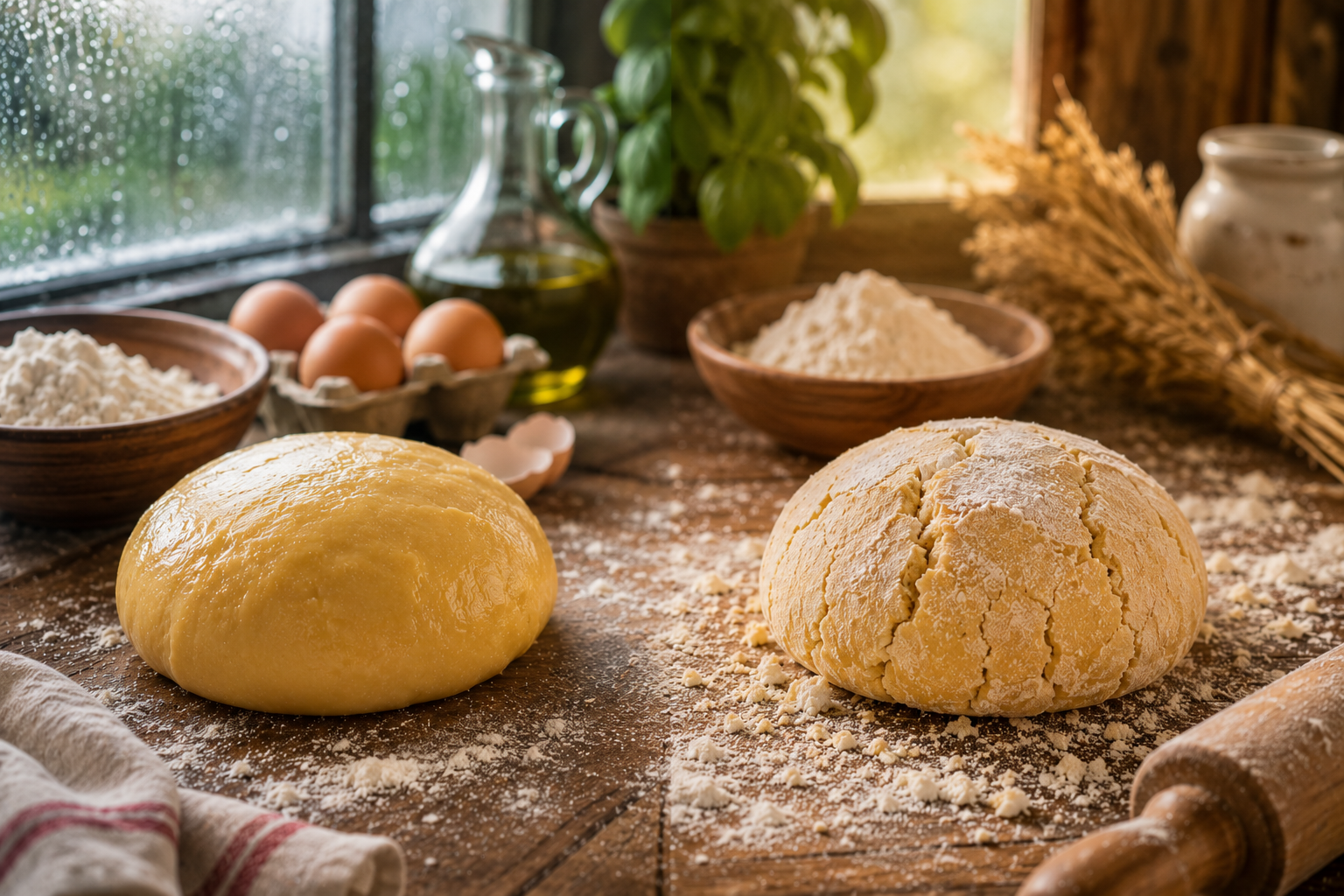
How Humidity and Weather Affect Homemade Pasta Dough (Part 1)
“One of the greatest mysteries for beginning pasta makers is discovering that the exact same recipe can produce completely different dough from one day to the next. The recipe didn’t change—but the environment did.”
Every pasta maker experiences it sooner or later.
Last weekend, your dough was perfect.
It came together effortlessly, kneaded beautifully, and rolled into silky sheets that seemed almost impossible to mess up.
A week later, using the exact same flour, the same eggs, the same measurements, and the same technique, something feels different.
The dough is sticky.
Or perhaps it’s dry and crumbly.
Maybe it tears while rolling or seems unusually stiff.
Naturally, you begin questioning yourself.
“Did I measure something incorrectly?”
“Did I overwork the dough?”
“Did I buy the wrong flour?”
In many cases, the answer is much simpler.
The weather changed.
Unlike many recipes that rely on precise measurements, pasta dough is a living mixture that constantly responds to its surroundings. Every handful of flour, every egg, and every minute spent kneading is influenced by conditions you often can’t see—including the moisture in the air itself.
For centuries, Italian pasta makers understood this instinctively.
They didn’t own hygrometers.
They didn’t monitor relative humidity.
They simply learned to observe the dough.
Today, food science helps explain exactly what they were experiencing all along.
Understanding how weather influences pasta is one of the biggest steps toward becoming a confident pasta maker.
Because once you stop expecting identical dough every time, you begin learning how to create consistent results instead.
Flour Is Never Truly Dry
Most people imagine flour as an ingredient that stays exactly the same from one day to the next.
In reality, flour behaves much more like a sponge.
Even while sitting quietly in your pantry, flour is constantly exchanging moisture with the surrounding air.
On humid days, flour naturally absorbs moisture from the atmosphere.
On dry days, it gradually releases moisture back into the air.
The changes may seem insignificant.
But when you’re working with a recipe that contains only two or three ingredients, even tiny differences become noticeable.
A single cup of flour today is not always identical to a cup of that same flour next month.
That’s why experienced pasta makers trust their hands more than measuring cups.
Humidity Changes Everything
Humidity simply describes how much water vapor exists in the air.
The higher the humidity, the more moisture your flour has likely absorbed before you even begin mixing.
Imagine leaving a kitchen sponge on your counter.
If it’s already damp, it can’t absorb much more water.
Flour behaves similarly.
When flour already contains additional moisture, adding your usual amount of eggs or water may create dough that feels softer or stickier than expected.
Nothing is wrong with the recipe.
The flour arrived at the mixing bowl already carrying extra moisture.
Dry Air Creates the Opposite Problem
Winter often presents the opposite challenge.
Indoor heating removes significant moisture from the air.
Flour becomes drier.
Wooden cutting boards become drier.
Even your hands become drier.
When extremely dry flour meets the same amount of liquid you used in summer, the dough may feel:
- Stiff
- Crumbly
- Difficult to combine
- Rough around the edges
Many beginners assume they’ve added too little liquid.
Sometimes that’s true.
Other times, the dough simply needs a few extra minutes to hydrate before making adjustments.
Patience often solves what extra water cannot.
Eggs Aren’t Identical Either
Humidity isn’t working alone.
Eggs introduce another variable.
No two eggs contain exactly the same amount of liquid.
A “large” egg may vary surprisingly from another large egg purchased just weeks later.
The age of the egg also matters.
Fresh eggs tend to behave slightly differently than older eggs.
Even the chickens’ diet and the season influence the composition of the eggs they produce.
Italian grandmothers weren’t measuring egg weights.
They were watching the dough.
That’s still one of the best habits a modern pasta maker can develop.
Why Italian Recipes Often Feel Flexible
Many people become frustrated when traditional Italian recipes say things like:
“Add flour as needed.”
Or…
“Use enough water to form a smooth dough.”
At first glance, those instructions seem vague.
Why not give an exact amount?
The answer is simple.
The cook cannot know the humidity in your kitchen.
They cannot know how much moisture your flour already contains.
They cannot know whether your eggs are slightly larger or slightly smaller than theirs.
Rather than pretending every kitchen is identical, traditional Italian recipes teach flexibility.
The recipe provides the starting point.
The dough provides the final answer.
Learning to Read the Dough
Perhaps the most valuable skill you’ll ever develop isn’t measuring.
It’s observing.
As you knead, ask yourself questions.
Does the dough feel tacky but manageable?
Is it cracking apart?
Does it smooth out after a few minutes?
Is it sticking aggressively to your hands?
Those answers matter far more than blindly following measurements.
Experienced pasta makers don’t chase perfect numbers.
They chase the correct feel.
And that feel changes slightly every single day.
Small Adjustments Make the Biggest Difference
One mistake beginners often make is trying to fix dough too quickly.
Sticky?
They add half a cup of flour.
Dry?
They pour in several tablespoons of water.
Suddenly, they’ve overcorrected.
Instead, think small.
Add flour one tablespoon at a time.
Add water a teaspoon at a time.
Then knead.
Wait.
Observe.
The dough often needs a moment to respond before you know whether another adjustment is necessary.
Tiny changes produce dramatic results.
Did You Know?
Professional pasta makers often say they “meet the dough where it is.”
Rather than forcing every batch to match yesterday’s conditions, they adjust slightly to whatever today’s flour, eggs, and weather require.
It’s one of the reasons handmade pasta retains its artisanal character.
Italian Word of the Day
Umidità (oo-mee-dee-TAH)
Meaning: Humidity.
While traditional Italian cooks rarely measured it, they certainly respected it. Whether rolling delicate tagliatelle in Bologna or shaping orecchiette in Puglia, experienced pasta makers understood that the air itself could influence the dough.
Regional Spotlight: Liguria
Along Italy’s northwestern coast, the sea plays a subtle role in everyday cooking. Coastal humidity can influence flour differently than the dry inland air found in other regions. Generations of Ligurian cooks learned to adapt naturally, relying on experience rather than rigid formulas.
It’s another reminder that Italian cooking has always been deeply connected to place—not just ingredients.
Coming in Part 2…
We’ll explore how changing seasons affect pasta making, the best ways to store flour, signs that your dough needs adjusting, and simple techniques professional pasta makers use to achieve consistent results throughout the year. We’ll also finish with our signature Pasta Fiore Tip and From the Pasta Fiore Kitchen section.