

How Humidity and Weather Affect Homemade Pasta Dough (Part 2)
In Part 1, we explored how humidity, temperature, flour, and even the size of your eggs can change the way pasta dough behaves. We discovered that making great pasta isn’t about following a recipe with absolute precision—it’s about learning to read the dough itself.
Now let’s look at how to recognize the signs your dough is giving you and how experienced Italian pasta makers make small adjustments without ever reaching for a measuring spoon.
Learning to Read the Dough
One of the biggest milestones in becoming a confident pasta maker is shifting your focus away from the recipe and toward the dough itself.
Recipes provide an excellent starting point, but dough is alive in a sense. It reacts to the environment around it.
The same recipe that worked perfectly yesterday may feel completely different today.
Instead of asking, “Did I measure correctly?” experienced cooks ask,
“What is my dough telling me?”
That simple shift in thinking changes everything.
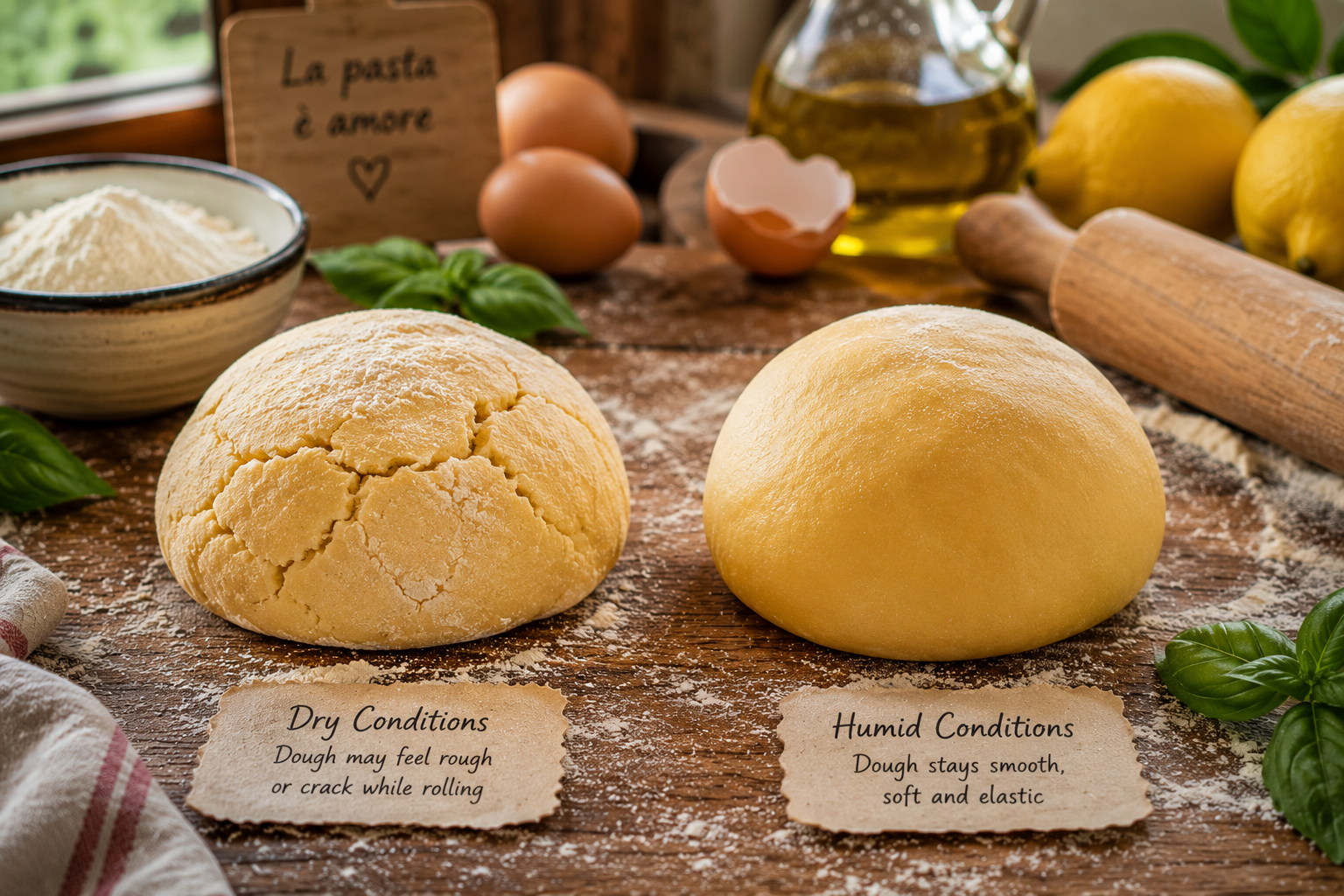
Signs Your Dough Is Too Dry
Dry dough usually announces itself quickly.
It may look rough or cracked instead of smooth.
Small pieces may crumble away while kneading.
As you begin rolling, the edges often split or tear before the center becomes thin.
Many beginners immediately assume they’ve done something wrong.
In reality, the dough may simply need a tiny bit more moisture.
Rather than adding another whole egg or a large splash of water, lightly dampen your fingertips and continue kneading.
Sometimes that’s all the dough needs.
If necessary, add moisture only a teaspoon at a time.
Patience almost always produces better results than making a dramatic correction.
Signs Your Dough Is Too Wet
Wet dough presents a different challenge.
Instead of feeling firm and silky, it clings stubbornly to your hands, the counter, and the rolling pin.
It may flatten instead of holding its shape.
The solution isn’t to bury it under handfuls of flour.
Too much additional flour changes the original balance of the recipe.
Instead, sprinkle a small amount of flour over the dough, knead thoroughly, then evaluate again.
Repeat only if necessary.
Small adjustments preserve the dough’s texture far better than one large correction.
Seasonal Pasta Making
Many Italian families notice predictable changes throughout the year.
Summer often brings warm, humid kitchens where flour naturally absorbs moisture from the air.
Winter tends to produce cooler, drier conditions, causing dough to feel firmer and thirstier.
Even rainy days and dry Santa Ana winds can influence how your dough behaves.
Professional pasta makers don’t fight these seasonal differences.
They expect them.
Every batch begins with observation.
Every adjustment is intentional.
That’s one reason handmade pasta continues to feel like a craft rather than a formula.
Why Digital Recipes Can’t Feel the Dough
Today, thousands of recipes promise “perfect pasta every time.”
Many provide exact gram measurements.
Those measurements are valuable—but they can’t account for your kitchen.
A recipe doesn’t know:
- Whether it’s 95°F outside.
- If your flour has been sitting in a humid pantry.
- How large today’s eggs are.
- Whether your kitchen is air-conditioned.
- How much moisture your particular brand of flour naturally absorbs.
Only your hands can recognize those differences.
That’s why the best pasta makers develop confidence through experience rather than strict precision.
Practice Builds Intuition
It’s easy to believe experienced pasta makers possess some secret knowledge.
In reality, they’ve simply handled thousands of batches of dough.
Every imperfect batch teaches something useful.
You begin recognizing textures.
You notice subtle changes.
Eventually, adjustments happen almost automatically.
That confidence doesn’t come from memorizing recipes.
It comes from repetition.
And that’s one of the greatest joys of learning handmade pasta.
Did You Know?
Traditional Italian pasta makers rarely describe dough using measurements alone. Instead, you’ll often hear phrases like “soft as your earlobe” or “smooth like silk.” These sensory comparisons have been passed down through generations because touch often communicates more than numbers ever could.
Italian Word of the Day
Consistenza (kohn-see-STEN-tsah)
Meaning: Consistency or texture.
When Italian cooks talk about the consistenza of pasta dough, they’re describing how it feels—not just how it looks. A smooth, balanced consistency is one of the best indicators that the dough is ready to rest or roll.
Regional Spotlight: Sicily
Sicily’s warm Mediterranean climate has influenced its pasta traditions for centuries. The island’s hot summers and dry conditions have long made durum wheat an ideal crop, leading to many of Italy’s famous semolina-based pastas.
Generations of Sicilian pasta makers learned to work with changing weather by adjusting their dough instinctively, relying on touch and experience rather than exact measurements. Their approach reminds us that understanding your ingredients is just as important as following a recipe.
Pasta Fiore Tip
Don’t judge your dough during the first two or three minutes of kneading.
Freshly mixed dough almost always looks rough, uneven, or slightly dry.
Give it time.
As the flour continues absorbing moisture and the gluten begins developing, the texture often changes dramatically.
Many “problem” doughs simply needed a few more minutes beneath your hands.
From the Pasta Fiore Kitchen
One of the most beautiful lessons homemade pasta teaches is that perfection isn’t found in rigid measurements—it’s found in paying attention.
The weather changes.
The seasons change.
Even the flour changes from one harvest to the next.
Yet for centuries, Italian pasta makers have continued producing extraordinary pasta because they learned to trust something more important than a recipe.
They trusted their hands.
Every batch of dough is a conversation between you, your ingredients, and your environment.
The more often you make pasta, the more clearly you’ll hear what that conversation is telling you.
And one day, almost without realizing it, you’ll stop worrying about whether the recipe is perfect.
You’ll know your dough is.