

The Role of Gluten in Homemade Pasta (Part 1)
“Gluten isn’t the enemy of great pasta—it’s one of the reasons great pasta exists.”
Few ingredients in modern cooking have become as misunderstood as gluten.
Depending on where you look, you’ll hear that gluten is harmful, unnecessary, or something every cook should avoid. Yet for thousands of years, Italian pasta makers have relied on gluten to create pasta that is silky, resilient, and capable of holding its shape from the moment it’s rolled until the last bite.
So which is true?
The answer is much simpler than the headlines suggest.
For those who do not have celiac disease or a medically diagnosed gluten sensitivity, gluten is simply a naturally occurring protein found in wheat. In pasta making, it isn’t an unwanted byproduct—it’s the invisible framework that gives dough its remarkable strength and elasticity.
Without gluten, traditional pasta simply wouldn’t behave the way we expect it to.
Understanding gluten is one of the biggest steps toward understanding why pasta dough works the way it does.
What Exactly Is Gluten?
Contrary to popular belief, gluten isn’t added to flour.
It’s already there.
Two naturally occurring proteins—gliadin and glutenin—live inside wheat flour. While dry, they remain separate and inactive.
The magic begins when water or eggs are introduced.
As moisture is absorbed and the dough is mixed, these proteins begin connecting to one another.
As kneading continues, those tiny connections multiply until they form an intricate web throughout the dough.
That web is what we call gluten.
Although invisible, it’s responsible for nearly everything we love about handmade pasta.
Think of Gluten Like a Fishing Net
Imagine laying hundreds of tiny strands of string across a table.
Individually, they’re weak.
Tie them together into a net, however, and suddenly they become incredibly strong while still remaining flexible.
That’s essentially what gluten does inside pasta dough.
It creates an elastic network capable of stretching, bending, folding, and rolling without falling apart.
Without that network, pasta dough would crumble the moment you tried rolling it through a machine or shaping it by hand.
Why Kneading Matters
One of the most common questions beginner pasta makers ask is:
“Why do I have to knead the dough for so long?”
The answer isn’t simply to mix the ingredients.
Every fold, push, and stretch strengthens the gluten network.
As you knead, those protein strands line up, intertwine, and become more organized.
At first, dough feels rough and shaggy.
It may tear easily.
It often resists rolling.
Continue kneading, however, and something remarkable happens.
The dough gradually transforms into a smooth, cohesive ball with a silky surface.
That transformation isn’t magic.
It’s gluten developing before your hands.
Strong—but Not Too Strong
Interestingly, the goal isn’t to create the strongest gluten possible.
It’s to create balanced gluten.
Too little development leaves dough weak and fragile.
Sheets tear.
Filled pasta bursts.
Shapes collapse during cooking.
Too much development creates a different problem.
The dough becomes overly tight and stubborn.
It springs back every time you try rolling it thinner.
This is why kneading and resting always work together.
Kneading builds gluten.
Resting relaxes it.
Neither step is complete without the other.
Different Flours Build Different Gluten
Not every flour behaves the same way.
One reason Italian cooks choose specific flours for specific pasta styles is because each contains a different amount of protein.
Higher-protein flours generally create stronger gluten networks.
Lower-protein flours create softer, more delicate dough.
This is why semolina flour produces pasta with a pleasantly firm bite, while finely milled “00” flour creates exceptionally smooth sheets for delicate filled pasta.
The best dough often combines the strengths of more than one flour.
It’s one reason many traditional pasta makers blend semolina with “00” flour rather than relying on a single type.
Eggs Change the Story
Eggs don’t create gluten.
Only wheat proteins can do that.
However, eggs dramatically influence how gluten behaves.
The fats in egg yolks help lubricate the gluten network, making dough smoother and more supple.
Meanwhile, the proteins in the egg whites contribute additional structure.
The result is a dough that’s both strong and tender—one reason egg pasta has become synonymous with northern Italy’s rich culinary traditions.
Gluten Gives Pasta Its Bite
One of the defining characteristics of excellent pasta is what Italians call al dente—literally, “to the tooth.”
That pleasant resistance comes largely from a healthy gluten network.
As pasta cooks, starches soften.
Meanwhile, gluten helps maintain structure so the pasta doesn’t become mushy.
The better the gluten development, the better the finished texture.
It’s one of the reasons handmade pasta can feel so satisfying to eat.
Did You Know?
Professional pasta makers rarely judge gluten development by time alone.
Instead, they rely on touch.
An experienced pasta maker can tell whether dough needs another minute of kneading simply by feeling how it stretches, folds, and springs back.
It’s a skill developed through repetition rather than measurement.
Italian Word of the Day
Elasticità (eh-las-tee-chee-TAH)
Meaning: Elasticity.
Italian pasta makers often describe well-developed dough as having the perfect elasticità—soft enough to stretch, yet strong enough to hold its shape.
Regional Spotlight: Emilia-Romagna
Often called the heart of fresh egg pasta, Emilia-Romagna is home to iconic shapes such as tagliatelle, tortellini, tortelloni, and lasagne verdi.
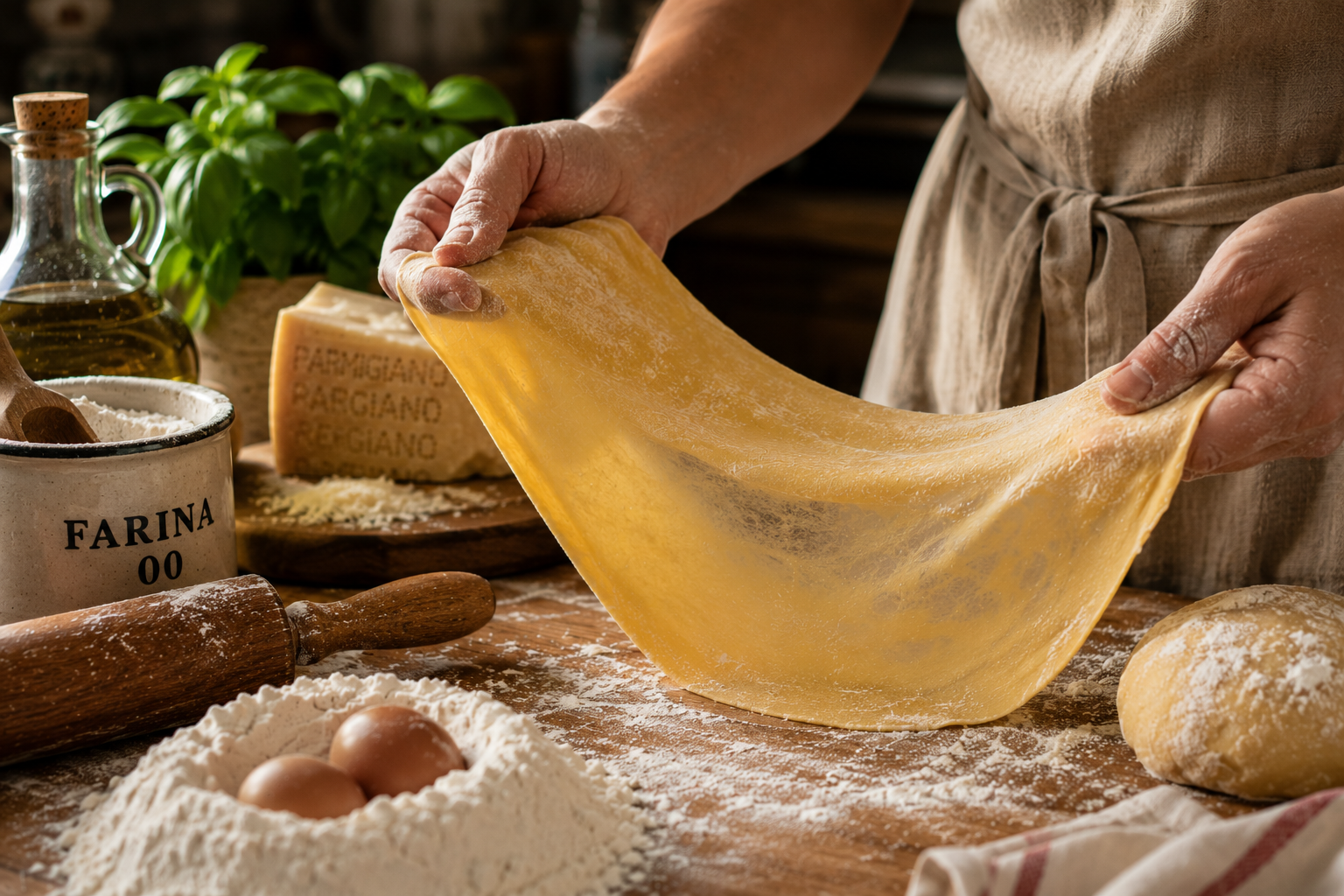
Generations of sfogline—women who specialize in hand-rolled pasta—have perfected the balance of kneading, resting, and rolling, creating dough so thin it’s traditionally said you should be able to read a love letter through it.
Their craft demonstrates just how essential proper gluten development is to producing extraordinary pasta.
Coming in Part 2…
We’ll explore how to tell when gluten is fully developed, the windowpane test, common mistakes that weaken dough, whether you can over-knead pasta by hand, how gluten affects different pasta shapes, and finish with another Pasta Fiore Tip and From the Pasta Fiore Kitchen.
Pasta Foundations #9
The Role of Gluten in Homemade Pasta (Part 1)
“Gluten isn’t the enemy of great pasta—it’s one of the reasons great pasta exists.”
Few ingredients in modern cooking have become as misunderstood as gluten.
Depending on where you look, you’ll hear that gluten is harmful, unnecessary, or something every cook should avoid. Yet for thousands of years, Italian pasta makers have relied on gluten to create pasta that is silky, resilient, and capable of holding its shape from the moment it’s rolled until the last bite.
So which is true?
The answer is much simpler than the headlines suggest.
For those who do not have celiac disease or a medically diagnosed gluten sensitivity, gluten is simply a naturally occurring protein found in wheat. In pasta making, it isn’t an unwanted byproduct—it’s the invisible framework that gives dough its remarkable strength and elasticity.
Without gluten, traditional pasta simply wouldn’t behave the way we expect it to.
Understanding gluten is one of the biggest steps toward understanding why pasta dough works the way it does.
What Exactly Is Gluten?
Contrary to popular belief, gluten isn’t added to flour.
It’s already there.
Two naturally occurring proteins—gliadin and glutenin—live inside wheat flour. While dry, they remain separate and inactive.
The magic begins when water or eggs are introduced.
As moisture is absorbed and the dough is mixed, these proteins begin connecting to one another.
As kneading continues, those tiny connections multiply until they form an intricate web throughout the dough.
That web is what we call gluten.
Although invisible, it’s responsible for nearly everything we love about handmade pasta.
Think of Gluten Like a Fishing Net
Imagine laying hundreds of tiny strands of string across a table.
Individually, they’re weak.
Tie them together into a net, however, and suddenly they become incredibly strong while still remaining flexible.
That’s essentially what gluten does inside pasta dough.
It creates an elastic network capable of stretching, bending, folding, and rolling without falling apart.
Without that network, pasta dough would crumble the moment you tried rolling it through a machine or shaping it by hand.
Why Kneading Matters
One of the most common questions beginner pasta makers ask is:
“Why do I have to knead the dough for so long?”
The answer isn’t simply to mix the ingredients.
Every fold, push, and stretch strengthens the gluten network.
As you knead, those protein strands line up, intertwine, and become more organized.
At first, dough feels rough and shaggy.
It may tear easily.
It often resists rolling.
Continue kneading, however, and something remarkable happens.
The dough gradually transforms into a smooth, cohesive ball with a silky surface.
That transformation isn’t magic.
It’s gluten developing before your hands.
Strong—but Not Too Strong
Interestingly, the goal isn’t to create the strongest gluten possible.
It’s to create balanced gluten.
Too little development leaves dough weak and fragile.
Sheets tear.
Filled pasta bursts.
Shapes collapse during cooking.
Too much development creates a different problem.
The dough becomes overly tight and stubborn.
It springs back every time you try rolling it thinner.
This is why kneading and resting always work together.
Kneading builds gluten.
Resting relaxes it.
Neither step is complete without the other.
Different Flours Build Different Gluten
Not every flour behaves the same way.
One reason Italian cooks choose specific flours for specific pasta styles is because each contains a different amount of protein.
Higher-protein flours generally create stronger gluten networks.
Lower-protein flours create softer, more delicate dough.
This is why semolina flour produces pasta with a pleasantly firm bite, while finely milled “00” flour creates exceptionally smooth sheets for delicate filled pasta.
The best dough often combines the strengths of more than one flour.
It’s one reason many traditional pasta makers blend semolina with “00” flour rather than relying on a single type.
Eggs Change the Story
Eggs don’t create gluten.
Only wheat proteins can do that.
However, eggs dramatically influence how gluten behaves.
The fats in egg yolks help lubricate the gluten network, making dough smoother and more supple.
Meanwhile, the proteins in the egg whites contribute additional structure.
The result is a dough that’s both strong and tender—one reason egg pasta has become synonymous with northern Italy’s rich culinary traditions.
Gluten Gives Pasta Its Bite
One of the defining characteristics of excellent pasta is what Italians call al dente—literally, “to the tooth.”
That pleasant resistance comes largely from a healthy gluten network.
As pasta cooks, starches soften.
Meanwhile, gluten helps maintain structure so the pasta doesn’t become mushy.
The better the gluten development, the better the finished texture.
It’s one of the reasons handmade pasta can feel so satisfying to eat.
Did You Know?
Professional pasta makers rarely judge gluten development by time alone.
Instead, they rely on touch.
An experienced pasta maker can tell whether dough needs another minute of kneading simply by feeling how it stretches, folds, and springs back.
It’s a skill developed through repetition rather than measurement.
Italian Word of the Day
Elasticità (eh-las-tee-chee-TAH)
Meaning: Elasticity.
Italian pasta makers often describe well-developed dough as having the perfect elasticità—soft enough to stretch, yet strong enough to hold its shape.
Regional Spotlight: Emilia-Romagna
Often called the heart of fresh egg pasta, Emilia-Romagna is home to iconic shapes such as tagliatelle, tortellini, tortelloni, and lasagne verdi.
Generations of sfogline—women who specialize in hand-rolled pasta—have perfected the balance of kneading, resting, and rolling, creating dough so thin it’s traditionally said you should be able to read a love letter through it.
Their craft demonstrates just how essential proper gluten development is to producing extraordinary pasta.
Coming in Part 2…
We’ll explore how to tell when gluten is fully developed, the windowpane test, common mistakes that weaken dough, whether you can over-knead pasta by hand, how gluten affects different pasta shapes, and finish with another Pasta Fiore Tip and From the Pasta Fiore Kitchen.