

Why Pasta Water Is Called “Liquid Gold” (Part 1)
“It may look like cloudy cooking water, but to Italian cooks, pasta water is one of the most valuable ingredients in the entire meal.”
Imagine watching an experienced Italian chef finish a plate of pasta.
Just before the dish is complete, they do something that often surprises home cooks.
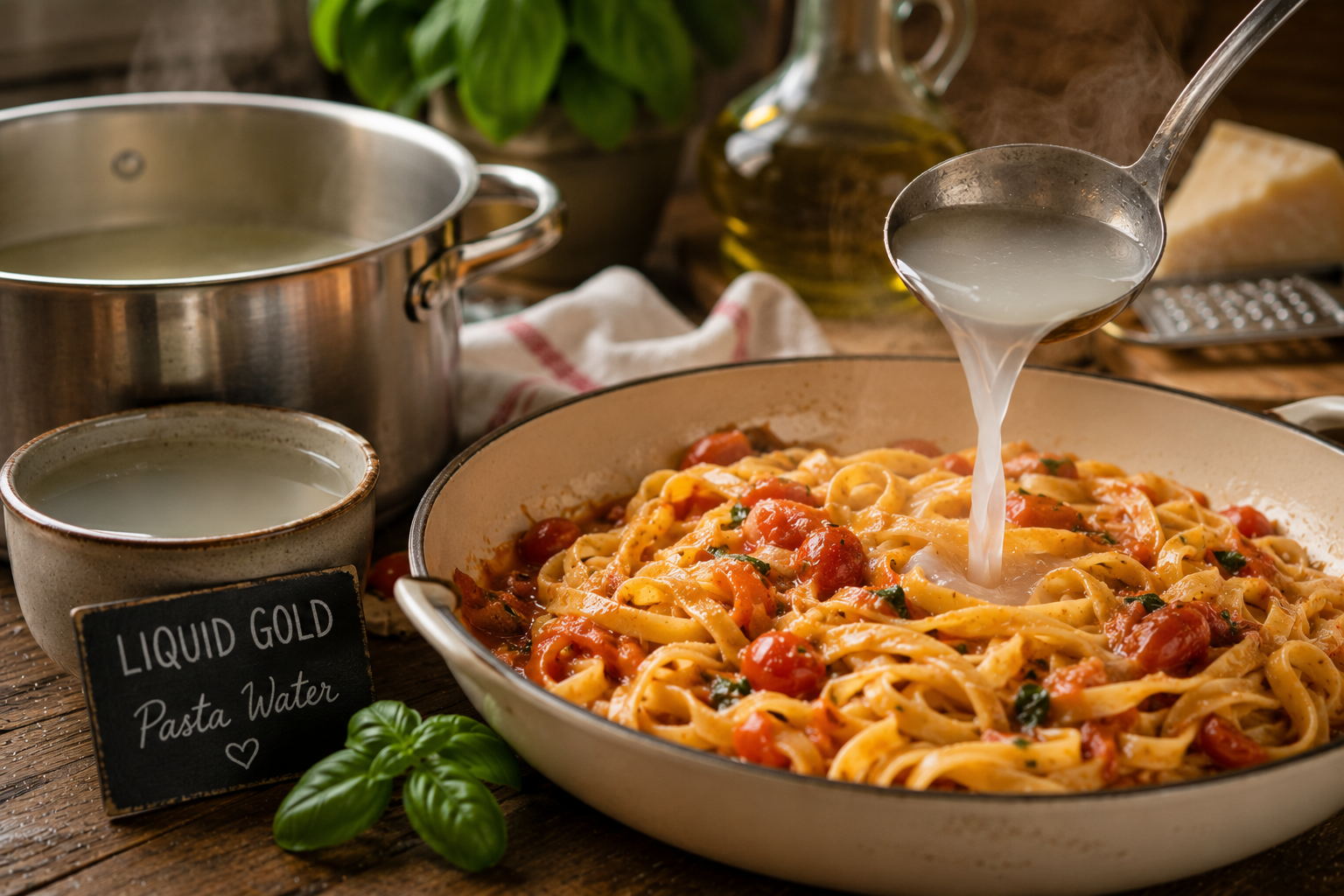
Instead of draining the pasta and throwing away the cooking water, they carefully dip a ladle into the pot and pour a small amount into the sauce.
At first glance, it seems strange.
Why would anyone intentionally add cloudy, starchy water to a perfectly good sauce?
Wouldn’t plain water do exactly the same thing?
The answer is one of the most fascinating lessons in Italian cooking.
That cloudy water isn’t simply leftover from boiling pasta.
It’s an ingredient.
In fact, many professional chefs affectionately call it “liquid gold.”
Not because it’s expensive.
Not because it’s rare.
But because of what it does to a sauce.
Understanding pasta water changes the way you cook forever.
It’s one of those small techniques that transforms homemade pasta from tasting good to tasting like it came from an Italian kitchen.
Why Does Pasta Water Turn Cloudy?
The answer begins with the flour itself.
Whether you’re cooking fresh homemade pasta or high-quality dried pasta, the surface of the pasta contains starch.
As the pasta cooks, some of that starch escapes into the surrounding water.
The result is the slightly cloudy appearance you’ve probably noticed countless times.
Many people assume that cloudiness means something has gone wrong.
In reality, it’s exactly what you want.
That cloudiness is evidence that your cooking water has become enriched with starch.
And starch is one of the most useful natural thickening agents in cooking.
What Is Starch?
Starch is a natural carbohydrate found in wheat and many other plants.
Inside pasta, starch gives structure and helps create the satisfying texture we love.
Once exposed to boiling water, starch begins absorbing moisture.
The granules swell.
Some remain inside the pasta.
Others slowly release into the cooking water.
That suspended starch gives pasta water its silky appearance and remarkable cooking properties.
What looks like ordinary water has become something entirely different.
Why Plain Water Doesn’t Work
A common mistake is assuming you can simply replace pasta water with fresh water.
Technically, both contain water.
But chemically, they’re very different.
Fresh water simply dilutes a sauce.
Starchy pasta water helps bind it together.
Think of it this way:
Plain water makes ingredients thinner.
Pasta water helps ingredients become one.
That difference is the secret behind many classic Italian pasta dishes.
The Science of Emulsification
One of the most important concepts in Italian cooking is emulsification.
Although the word sounds technical, the idea is surprisingly simple.
Oil and water naturally separate.
Shake a bottle of vinaigrette, and the ingredients combine briefly before separating again.
Pasta sauces face the same challenge.
Butter.
Olive oil.
Rendered meat fat.
Cream.
All contain fat.
Tomatoes, wine, and broth contain water.
Without help, these components don’t always stay together smoothly.
The starch suspended in pasta water acts as a bridge between them.
It encourages the fat and water to combine into one silky, cohesive sauce.
Instead of looking greasy or watery, the sauce becomes glossy and luxurious.
This is one of the defining characteristics of authentic Italian pasta dishes.
Why Restaurant Pasta Tastes Different
Many people visit Italy—or a great Italian restaurant—and notice something difficult to describe.
The sauce doesn’t simply sit on top of the pasta.
It seems to become part of it.
Every strand appears evenly coated.
The sauce clings beautifully instead of pooling on the plate.
This isn’t magic.
It’s technique.
Professional cooks finish the pasta in the sauce with a small amount of reserved pasta water.
As the pasta continues cooking for another minute or two, the starch helps the sauce wrap around every noodle.
The result is harmony.
Pasta and sauce become one dish instead of two separate components sharing the same plate.
Less Sauce, Better Pasta
This idea surprises many people outside Italy.
When serving pasta, the goal isn’t usually to drown it in sauce.
Instead, the sauce should lightly coat every piece.
Pasta water makes this possible.
Rather than adding extra cream or butter to increase volume, Italian cooks often add a splash of pasta water.
The starch stretches the sauce naturally while maintaining its richness.
A smaller amount of sauce suddenly feels abundant because every noodle is evenly coated.
It’s a beautiful example of Italian cooking’s philosophy of simplicity and balance.
Fresh Pasta and Dried Pasta Both Create Starch
Some people believe only dried pasta produces useful pasta water.
That’s not true.
Fresh pasta also releases starch during cooking.
Because fresh pasta cooks much more quickly, the water may contain slightly less starch overall.
However, it still provides enough to help emulsify sauces beautifully.
In either case, reserving a cup of cooking water before draining the pasta is one of the easiest habits a home cook can develop.
Salt Matters Too
Traditional Italian pasta water is heavily salted.
Many chefs describe it as tasting “like the sea.”
The salt seasons the pasta itself while also lightly seasoning the water you’ll later add to the sauce.
This creates another advantage over plain water.
You’re not simply adding moisture.
You’re adding moisture that’s already carrying flavor.
It’s another small detail that contributes to the finished dish.
Did You Know?
Many of Italy’s most famous pasta dishes—including Cacio e Pepe, Aglio e Olio, and Carbonara—depend heavily on starchy pasta water.
Without it, these iconic sauces often become clumpy, greasy, or separated instead of silky and smooth.
Italian Word of the Day
Acqua di Cottura (AHK-kwah dee koht-TOO-rah)
Meaning: Cooking water.
In Italian kitchens, acqua di cottura della pasta simply means the water used to cook pasta—but experienced cooks know it’s much more than that. It’s an ingredient that’s added back into the sauce to create the perfect consistency and texture.
Regional Spotlight: Rome
Some of Rome’s most beloved pasta dishes rely on only a handful of ingredients. Cacio e Pepe, for example, traditionally combines Pecorino Romano cheese, black pepper, and starchy pasta water to create a remarkably creamy sauce—without a drop of cream.
It’s a beautiful demonstration of one of Italian cuisine’s greatest strengths: achieving extraordinary flavor through technique rather than complexity.
Coming in Part 2…
We’ll explore exactly how and when to reserve pasta water, how much to use, common mistakes that waste its potential, and why rinsing pasta can undo much of the work you’ve just done. We’ll finish with our Pasta Fiore Tip and From the Pasta Fiore Kitchen to help you put this knowledge into practice.