

The Role of Gluten in Homemade Pasta (Part 2)
In Part 1, we explored what gluten is, how it forms, and why it gives pasta dough its remarkable strength and elasticity. We learned that gluten isn’t something added to flour—it’s a natural protein network that develops through hydration and kneading.
Now let’s look at how to recognize properly developed gluten, avoid common mistakes, and understand why mastering gluten is one of the biggest steps toward making exceptional homemade pasta.
How Do You Know When Gluten Is Fully Developed?
One of the challenges for new pasta makers is knowing when enough kneading is enough.
Unlike baking bread, where recipes often specify exact kneading times, pasta dough is judged primarily by feel.
A properly developed dough should be:
- Smooth rather than rough
- Firm but not hard
- Slightly springy when pressed
- Easy to stretch without immediately tearing
- Uniform in color with no dry patches
When you gently press your finger into the dough, it should slowly spring back rather than leaving a deep indentation.
This tells you that the gluten network has developed enough to provide structure while remaining flexible.
The Windowpane Test
Bread bakers often use something called the windowpane test, and it can also be useful for pasta dough.
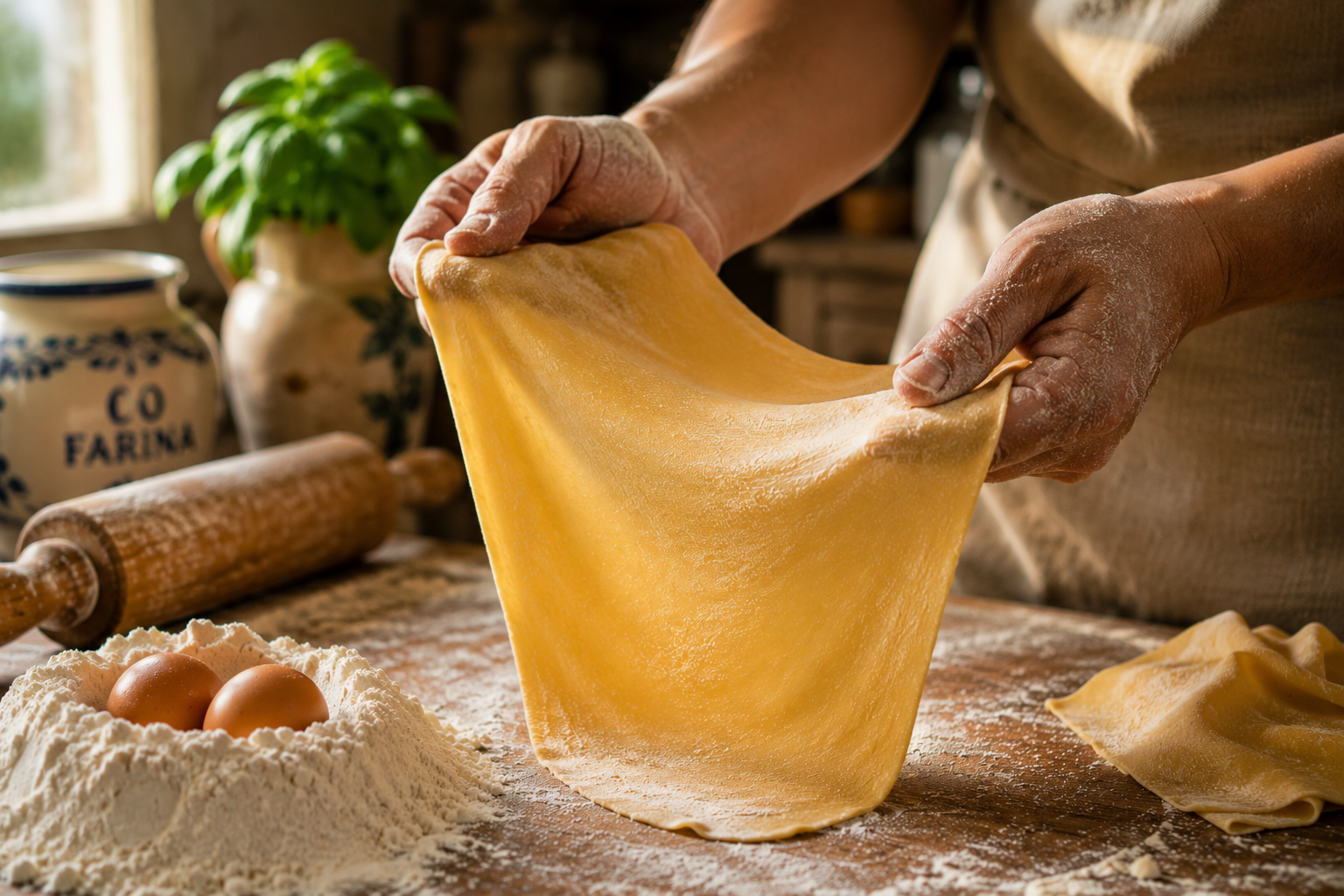
After allowing the dough to rest, pinch off a small piece and gently stretch it between your fingers.
If the dough stretches into a very thin sheet before tearing, the gluten network is well developed.
If it tears immediately or breaks apart into rough edges, it likely needs additional kneading or a longer resting period.
While many experienced pasta makers rely on touch alone, the windowpane test is an excellent learning tool for beginners.
Can You Over-Knead Pasta by Hand?
Fortunately, it’s surprisingly difficult.
Unlike commercial mixers that work at high speed, human hands develop gluten much more gradually.
For most home cooks, under-kneading is far more common than over-kneading.
In fact, many beginners stop just before the dough reaches its ideal texture because they’re unsure if they’re doing too much.
If your dough still looks rough or feels crumbly after only five minutes of kneading, keep going.
Most homemade pasta dough benefits from eight to twelve minutes of steady kneading, depending on the flour, hydration, and room conditions.
Your hands are unlikely to overwork it.
Why Resting Is Just as Important
Building gluten is only half the process.
Once kneading is complete, those gluten strands remain under tension.
Imagine stretching a rubber band.
The more you pull it, the more it wants to snap back.
Freshly kneaded dough behaves the same way.
Resting allows those stretched protein strands to relax.
This is why dough that was impossible to roll immediately after kneading suddenly becomes cooperative after resting for thirty minutes.
Kneading creates strength.
Resting creates flexibility.
Together, they produce dough that’s both durable and easy to work with.
How Gluten Affects Different Pasta Shapes
Every pasta shape places different demands on the dough.
Long ribbons such as tagliatelle require dough that rolls thinly without tearing.
Filled pastas like ravioli and tortellini need enough strength to survive filling, sealing, and boiling without bursting.
Decorative shapes such as corzetti must hold detailed impressions without losing their pattern.
Even hand-rolled shapes like pici, trofie, or cavatelli depend on balanced gluten development to maintain their form while remaining pleasantly tender.
In every case, gluten quietly supports the finished product.
Although diners never see it, they experience it in every bite.
Why Experience Matters More Than Measurements
Recipes are valuable guides.
But no recipe can account for today’s humidity, this bag of flour, the size of your eggs, or the temperature of your kitchen.
That’s why experienced pasta makers pay more attention to the dough than the recipe.
They watch how it stretches.
They notice how it feels beneath their hands.
They adjust instinctively.
Over time, you’ll find yourself doing the same.
Instead of wondering whether you’ve added exactly the right amount of water or flour, you’ll begin asking a much better question:
“What is my dough telling me?”
That’s the moment your confidence begins to grow.
Common Gluten Myths
Modern food culture has created plenty of misconceptions about gluten.
Let’s separate a few myths from reality.
Myth: More gluten always makes better pasta.
Not necessarily.
Strong gluten is helpful, but balanced gluten is the goal. Dough that becomes overly tight can be difficult to roll and shape.
Myth: You should knead until your arms hurt.
Quality matters far more than force.
Steady, consistent kneading develops gluten more effectively than aggressive handling.
Myth: Resting is optional.
Quite the opposite.
Even perfectly kneaded dough can become frustrating to work with if it hasn’t had time to rest.
Myth: Gluten makes pasta chewy.
Properly developed gluten doesn’t create toughness.
It creates structure, allowing the pasta to remain tender while holding its shape during cooking.
Did You Know?
Traditional Italian sfogline—master pasta makers in Emilia-Romagna—can often judge whether dough is ready simply by the sound it makes as it’s rolled across a wooden board.
Generations of experience have taught them to trust their senses just as much as measurements.
Italian Word of the Day
Impasto (eem-PAHS-toh)
Meaning: Dough.
In Italy, impasto refers to the mixed dough before it becomes pasta, bread, or pizza. Every great pasta dish begins with an impasto that has been properly kneaded, rested, and understood.
Regional Spotlight: Tuscany
Tuscany is famous for rustic, hand-rolled pasta varieties such as Pici, a thick, rope-like noodle traditionally made by rolling dough by hand across a wooden surface.
Although the dough itself is simple, its success depends on balanced gluten development. Too little strength and the strands break apart; too much, and they resist stretching into their characteristic long, irregular shape.
It’s another reminder that the beauty of handmade pasta often comes from mastering the fundamentals rather than adding complexity.
Pasta Fiore Tip
Instead of timing your kneading with a stopwatch, pay attention to the transformation happening beneath your hands.
When the dough changes from rough and shaggy to smooth, elastic, and silky, you’re no longer just following a recipe—you’re learning to communicate with the dough.
That skill will serve you far better than memorizing any number of minutes.
From the Pasta Fiore Kitchen
One of the most rewarding parts of learning to make pasta is discovering that the dough begins to speak to you.
At first, every batch feels uncertain.
You wonder if it’s too dry, too wet, too firm, or too soft.
Then, almost without realizing it, something changes.
You stop measuring success by the recipe and begin measuring it by touch.
You recognize when the dough needs another sprinkle of flour, another splash of water, or simply another few minutes beneath your hands.
That quiet confidence is how generations of Italian pasta makers learned their craft—not by chasing perfection, but by paying attention.
Gluten may be invisible, but its lessons aren’t.
It teaches patience, observation, and the understanding that some of the strongest things are built slowly, one fold at a time.
That’s the heart of handmade pasta—and one of the greatest joys of making it yourself.