

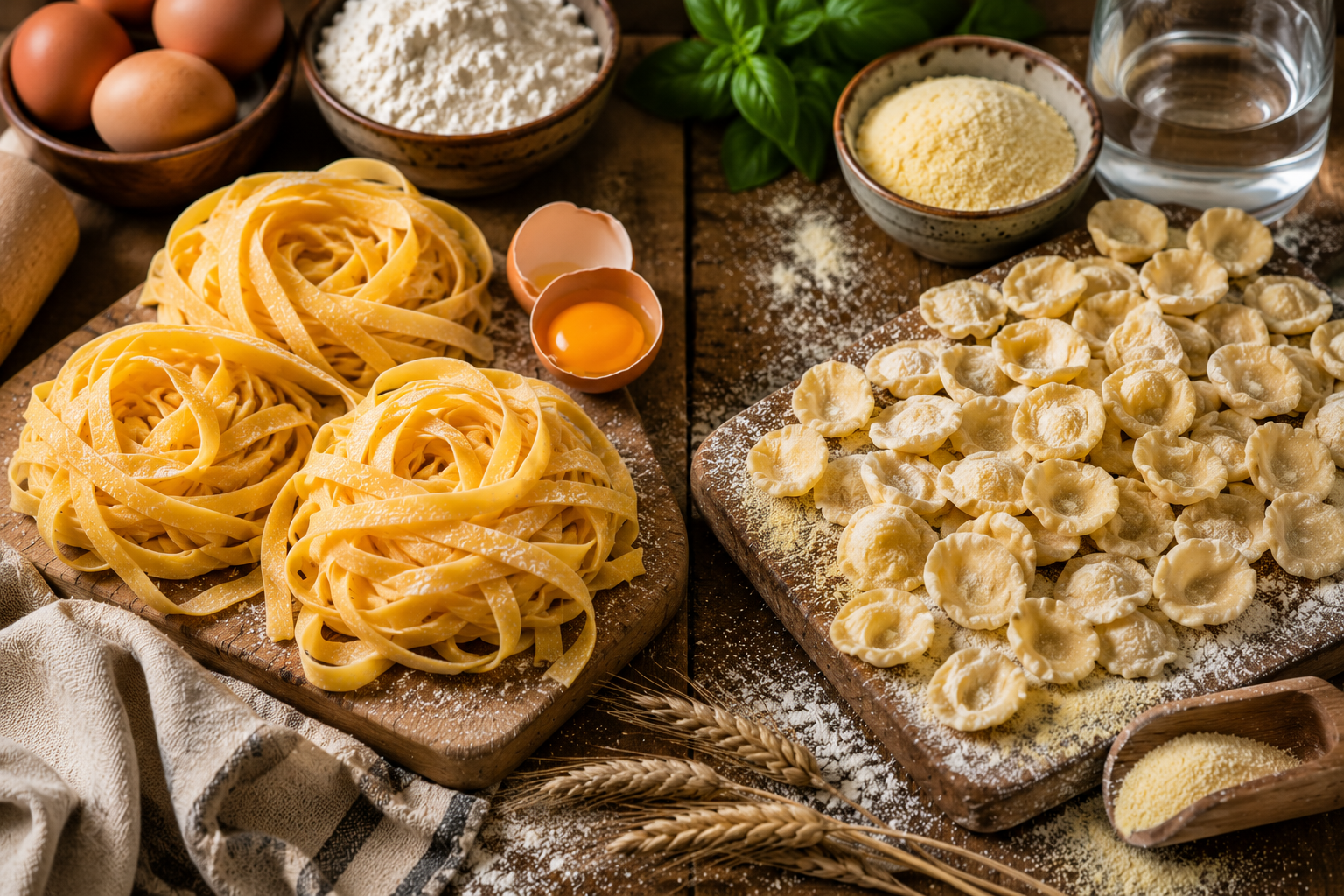
Egg Pasta vs. Water Pasta: Why Italy Uses Both (Part 1)
“One of the biggest misconceptions about Italian pasta is that authentic pasta always contains eggs. In reality, millions of Italians have been making extraordinary pasta for centuries using nothing more than flour and water.”
Walk into an Italian grandmother’s kitchen in Bologna, and you might find fresh golden tagliatelle drying on a wooden rack, its rich color coming from an abundance of egg yolks carefully kneaded into finely milled flour.
Travel several hundred miles south to Puglia, however, and you may watch another grandmother shaping orecchiette from a simple dough made with only semolina flour and warm water. There are no eggs on the counter. There never were.
Both women are making authentic Italian pasta.
Neither recipe is more traditional than the other.
This surprises many people outside of Italy. Cookbooks, television shows, and social media often present egg pasta as the “real” homemade pasta while treating water-based dough as a substitute or shortcut. That couldn’t be further from the truth.
Italy’s pasta traditions were never built around a single recipe. They were built around geography, agriculture, economics, climate, and generations of families learning to cook with what their land provided.
To truly understand Italian pasta, you have to understand why one village reached for eggs while another reached for water.
Only then does it become clear that these two doughs aren’t competing with one another—they’re solving different culinary problems.
There Is No Single “Italian Pasta Dough”
Ask someone for “the authentic pasta recipe,” and you’re likely to receive dozens of different answers.
That’s because Italy has never had one universal pasta dough.
Instead, every region developed recipes based on its own traditions.
Some relied heavily on eggs.
Others almost never used them.
Some mixed soft wheat flour.
Others depended almost entirely on durum wheat semolina.
Even neighboring villages sometimes developed different techniques because of the crops they grew, the livestock they raised, or the climate they lived in.
This incredible diversity is one of the reasons Italian cuisine remains so fascinating today.
Rather than trying to standardize recipes, Italians traditionally perfected what worked best where they lived.
Italy’s Geography Shaped Its Pasta
To understand why northern Italy embraced egg pasta while much of southern Italy favored water doughs, we first need to understand Italy itself.
Stretching over 700 miles from the Alps to the Mediterranean, Italy contains an extraordinary variety of climates.
The north experiences colder winters, fertile plains, and abundant dairy farming.
The south enjoys warmer temperatures, drier conditions, olive groves, and some of the world’s finest durum wheat.
These environmental differences influenced nearly everything Italians ate.
Rather than transporting ingredients across the country—which historically was expensive and difficult—families relied on what could be grown nearby.
The result was regional cuisine in its purest form.
Food wasn’t invented according to trends.
It evolved according to necessity.
Northern Italy: The Home of Egg Pasta
Northern Italy became famous for rich fresh egg pasta largely because eggs were relatively available.
Families often raised chickens.
Fresh eggs could be collected daily.
Butter, cheese, and dairy products were also abundant thanks to extensive cattle farming.
Soft wheat flour grew well throughout much of northern Italy, producing a silky dough that rolled beautifully into thin sheets.
Instead of drying pasta for storage, many families prepared fresh pasta specifically for that day’s meal or for Sunday gatherings.
Eggs added richness, flexibility, and beautiful golden color.
Over generations, this style became deeply rooted in northern Italian cooking.
Today, some of Italy’s most celebrated egg pastas come from these regions.
Emilia-Romagna
Often considered the culinary capital of Italy, Emilia-Romagna is home to classics like:
- Tagliatelle
- Tortellini
- Cappelletti
- Lasagne
- Anolini
Many traditional recipes call for a surprisingly high number of egg yolks, creating an incredibly rich dough that pairs beautifully with butter, cream, Parmigiano Reggiano, and slow-cooked ragù.
Piedmont
Piedmont is famous for luxurious egg pasta often served with butter, sage, truffles, mushrooms, and rich meat sauces.
Its agnolotti demonstrate just how thin and delicate egg dough can become while still holding flavorful fillings.
Lombardy
Filled pasta such as casoncelli and various regional ravioli showcase another strength of egg pasta—its ability to stretch thinly while remaining strong enough to seal around fillings.
Across northern Italy, eggs became part of the culinary identity because they complemented both the local ingredients and the cooking traditions.
Southern Italy: The Beauty of Flour and Water
Travel south, and the story changes.
Here, pasta often reflects a completely different agricultural landscape.
Durum wheat thrives in the warmer, drier climate of southern Italy.
Unlike softer wheats used in many northern doughs, durum wheat produces semolina—a coarse, golden flour with exceptional strength.
When mixed with water, semolina creates a dough that is:
- Firm
- Elastic
- Chewy
- Durable
- Excellent for shaping by hand
This dough doesn’t need eggs to become delicious.
In fact, adding eggs would often change the texture that these traditional shapes were designed to have.
Many southern pasta shapes intentionally provide a satisfying chew that complements olive oil, vegetables, seafood, legumes, and tomato-based sauces.
Their character comes from the wheat itself.
Durum Wheat Is the Star
Semolina deserves much of the credit for southern Italy’s remarkable pasta traditions.
Durum wheat contains high levels of protein and forms a strong gluten network when hydrated properly.
This creates dough that:
- Holds detailed shapes
- Maintains its structure during cooking
- Provides excellent bite
- Dries exceptionally well
- Works beautifully with rustic shaping techniques
Because of these natural qualities, water becomes all that’s necessary.
The wheat supplies the rest.
Many people are surprised to discover that some of Italy’s oldest pasta traditions rely on nothing more than these two ingredients.
Flour.
Water.
Time.
Famous Water-Based Pastas
Water doughs produce many of Italy’s most recognizable regional shapes.
Orecchiette
Perhaps the most famous pasta from Puglia, orecchiette means “little ears.”
Each piece is shaped by dragging a knife across the dough before turning it inside out over the thumb.
The rough exterior captures sauce beautifully.
Its chewy texture would feel completely different if made with rich egg dough.
Cavatelli
Found throughout southern Italy, cavatelli are rolled into small shells with a hollow center.
Their semolina dough gives them enough firmness to pair wonderfully with vegetables, broccoli rabe, sausage, tomato sauce, or simple olive oil preparations.
Trofie
This twisted Ligurian pasta is traditionally made without eggs.
Its spiral shape traps pesto exceptionally well.
The slight chew from the water dough perfectly complements the rich basil sauce.
Pici
Originating in Tuscany, pici are thick, hand-rolled strands that resemble oversized spaghetti.
Made simply with flour and water, they have a wonderfully rustic texture that works beautifully with garlic sauces, ragù, or cacio e pepe.
Why Eggs Change Everything
Eggs do much more than add flavor.
Every part of the egg influences the dough.
The Yolk
Egg yolks contribute:
- Fat
- Lecithin
- Color
- Richness
- Tenderness
The fats coat portions of the gluten network, making the finished pasta smoother and silkier.
They also create the beautiful golden color many people associate with handmade pasta.
Recipes using additional yolks become especially luxurious.
This is why many traditional tagliatelle recipes call for extra yolks rather than whole eggs alone.
The White
Egg whites provide:
- Water
- Protein
- Structure
The proteins strengthen the dough while the water hydrates the flour.
Together, yolks and whites create a balanced dough that’s flexible enough for rolling yet durable enough for shaping.
Water Creates a Different Kind of Strength
Water-only dough behaves differently.
Instead of relying on fat from egg yolks, it develops strength almost entirely through gluten formation.
The dough often feels:
- Firmer
- Less sticky
- More resistant during kneading
- More elastic
- More rustic
Many beginners mistake this firmness for poor dough.
In reality, it’s exactly what many traditional southern shapes require.
That stronger gluten network allows the pasta to hold ridges, grooves, and hand-shaped textures remarkably well.
Why Texture Matters More Than Flavor
Many people assume eggs exist primarily for flavor.
While they certainly add richness, their greatest contribution may actually be texture.
Imagine biting into fresh tagliatelle coated with butter and Parmigiano Reggiano.
The noodles almost melt.
Now imagine chewing through perfectly made orecchiette tossed with broccoli rabe and sausage.
There’s resistance.
There’s chew.
There’s structure.
Neither texture is better.
They’re simply different.
Italian cooks developed each dough specifically for the dishes they intended to prepare.
Texture came first.
Everything else followed.
Did You Know?
Some traditional families in Emilia-Romagna still judge pasta dough by color alone.
Older pasta makers can often estimate whether the dough contains enough yolks simply by its golden hue before it is ever rolled.
For generations, measurements weren’t written down—they were learned by sight, touch, and experience.
Italian Word of the Day
Pasta all’uovo (PAH-stah ahl OO-oh-voh)
Literally translated, it means “egg pasta.”
You’ll often see this phrase in Italy when referring to fresh dough made with eggs, particularly in northern regions.
It distinguishes egg-based pasta from pasta di semola, which is made primarily from semolina flour and water.
Regional Spotlight: Emilia-Romagna
If one region could be called the spiritual home of egg pasta, Emilia-Romagna would almost certainly earn that title.
Its fertile farmland, abundance of eggs, world-famous cheeses, and centuries-old culinary traditions created the perfect environment for fresh pasta to flourish.
Cities like Bologna, Modena, Parma, and Reggio Emilia continue to celebrate handmade egg pasta as an essential part of everyday life.
In many homes, rolling pasta by hand is still considered less of a recipe and more of a family tradition passed lovingly from one generation to the next.Next: In Part 2, we’ll explore which sauces pair best with each dough, debunk common myths about egg and water pasta, explain when to choose one over the other, and discover why understanding these traditions will make you a better pasta maker—not just a better cook.